

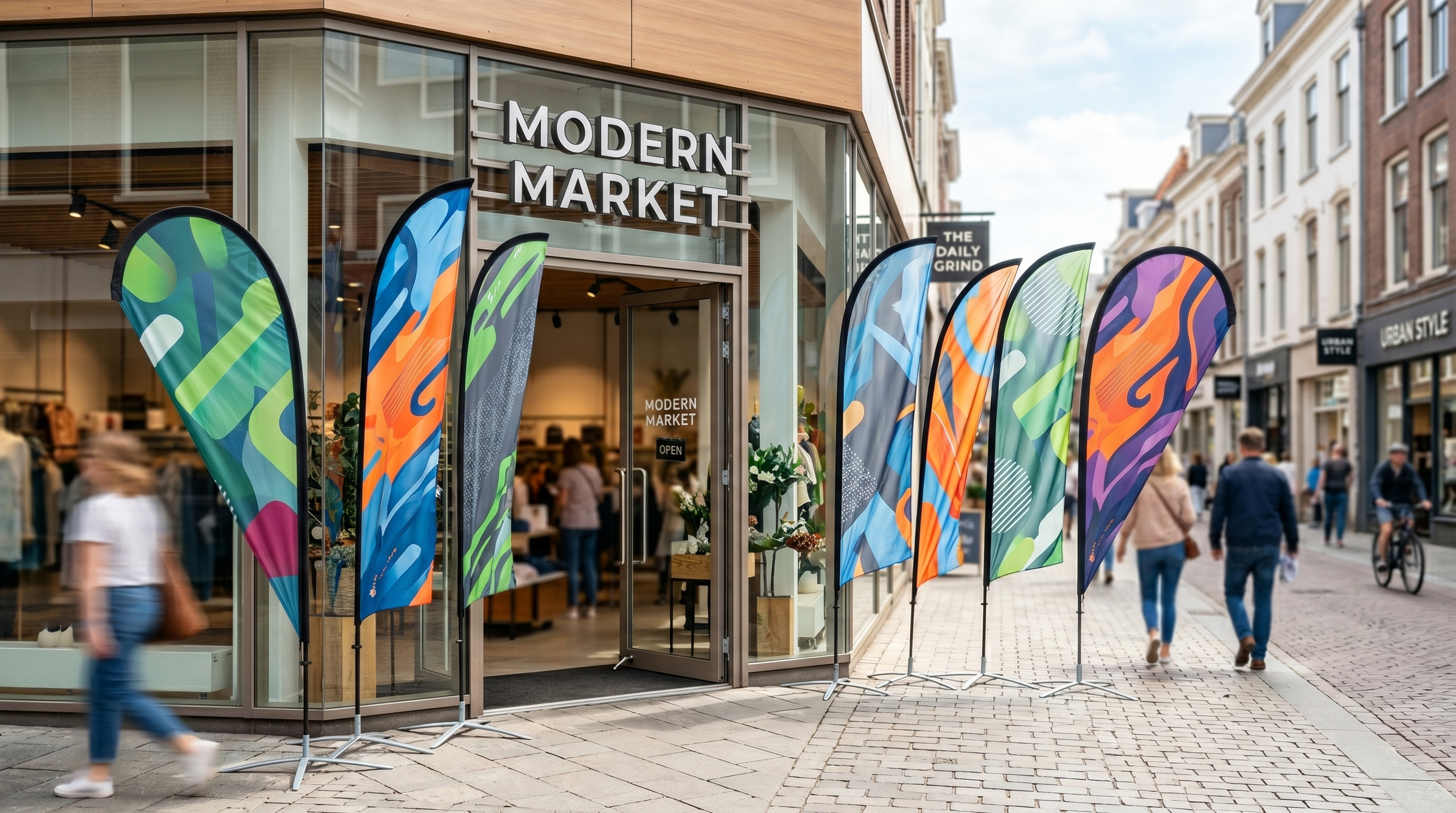
Professional guide · Advertising flags
Flying banner: what it is, types and how to choose your advertising flag
In physical stores, trade fairs, events and promotional campaigns, capturing attention in just a few seconds can make all the difference. A flying banner lets you communicate a promotion, mark an entrance or strengthen your brand image with a vertical, visible, lightweight and easy-to-transport display.
Also known as an advertising flag, fly banner, flag banner or promotional flag, this display stands out for its vertical format and its ability to communicate a brand message directly. It can be installed indoors, outdoors, at trade fairs, store entrances, sporting events, car dealerships, terraces, temporary promotions or street marketing campaigns.
In this guide, we explain everything you need to know before choosing a custom flying banner: what it is, what it is used for, what types exist, how to design it, where to place it, what mistakes to avoid and why it can be a very profitable investment for your business.
In this guide you will find:
What is a flying banner or advertising flag?

Vertical visibility
A portable advertising flag to make your message stand out
A flying banner is a vertical advertising flag made up of a printed fabric, a flexible pole and a support base. Its main purpose is to attract attention and communicate a brand, promotional or signage message quickly and visually.
It is especially used in places with pedestrian traffic: shopping streets, store entrances, trade fairs, events, sports centres, exhibitions, beaches, car dealerships or restaurant areas.
Thanks to its height and its natural movement when placed outdoors, it is more visible than many traditional posters. The key to this display is its ability to attract attention without taking up too much space. An advertising flag can be placed next to a store entrance, beside a stand or in a walkway area without requiring major installation.
The design of a flying banner is usually simple and direct. It commonly includes the company logo, corporate colours, a promotion or a call to action. In many cases, there is no need to add too much text. In fact, the clearer the message, the better it will perform.
Flying banner, fly banner and flag banner: main differences
The terms flying banner, fly banner and flag banner are often used to refer to very similar products. They all describe a portable, printed advertising flag mounted on a lightweight structure.
In English, the most common terms are advertising flag, flag banner, flying banner or promotional flag. When the format has a teardrop shape, it is often called a teardrop flag.
Cashdisplay tip
Before choosing the format, think about where the flag will be seen: store entrance, trade fair, beach, car dealership, terrace or sporting event. The location influences the most suitable size, shape and base.
Advantages of using a flying banner
The success of the flying banner comes from combining several advantages in one product. It is affordable compared with other large-format displays, easy to assemble, convenient to transport and offers strong visual impact.
For a business that wants to highlight its entrance, announce a promotion or reinforce its brand image, an advertising flag can be a very effective solution. It does not require permanent installation, it can be moved whenever necessary and it lets you adapt your message to each campaign.
A flying banner increases the visibility of your business
One of the main advantages of the flying banner is its visibility. With its vertical format and height, it allows the message to stand out above other elements in the surrounding area. This is especially useful in streets with many shops, trade fairs with multiple exhibitors or events with a large number of visual stimuli.
Outdoors, the movement of the fabric adds dynamism. The human eye easily detects moving elements, so a flying banner can naturally attract attention without the need for more complex advertising displays.
It is an easy-to-transport advertising display
Another important advantage of the fly banner is its portability. It is usually made up of detachable parts that can be stored in a carrying bag. This makes it easy to take to trade fairs, events, outdoor promotions or travelling sales campaigns.
For companies that regularly participate in events, this feature is highly valuable. A sales team can transport the custom flying banner together with brochures, samples, folding counters or other promotional materials without needing complex logistics.
It allows flexible and customised communication
The flying banner adapts to different types of campaigns. It can be used to announce a promotion, signpost an entrance, reinforce brand image, highlight a product, guide event attendees or decorate a commercial space.
This flexibility makes the custom flying banner a very useful tool for businesses that need to change their communication according to the season, campaign or event.
The most common types of flying banner
There are different types of flying banner, and each has its own characteristics. The choice of format will depend on the style you want to convey, the available space and the type of message to be printed.
The most common models are the teardrop flag, the sail flag and the rectangular flag banner. They all perform a similar function, but offer a different appearance and adapt better to specific uses.
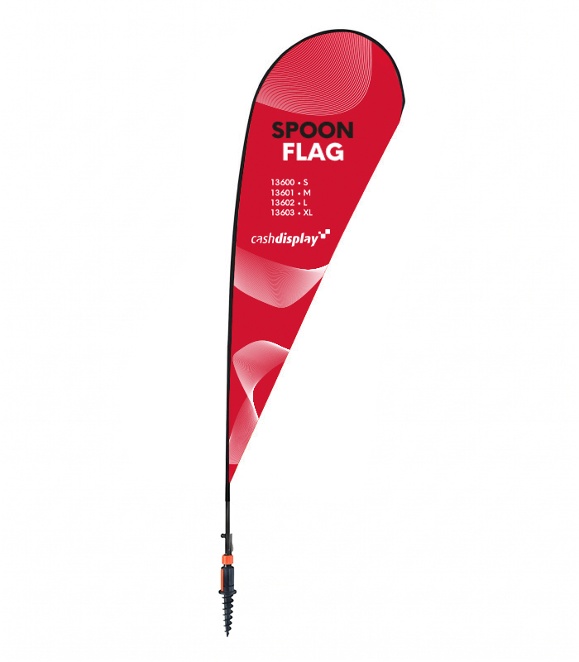
Teardrop type
Teardrop flag for promotions, sporting events, trade fairs and high-impact outdoor campaigns.
View product
Sail type
Sail or surf-shaped format, stylish and professional for fairs, hotels, dealerships and corporate events.
View product
Rectangular
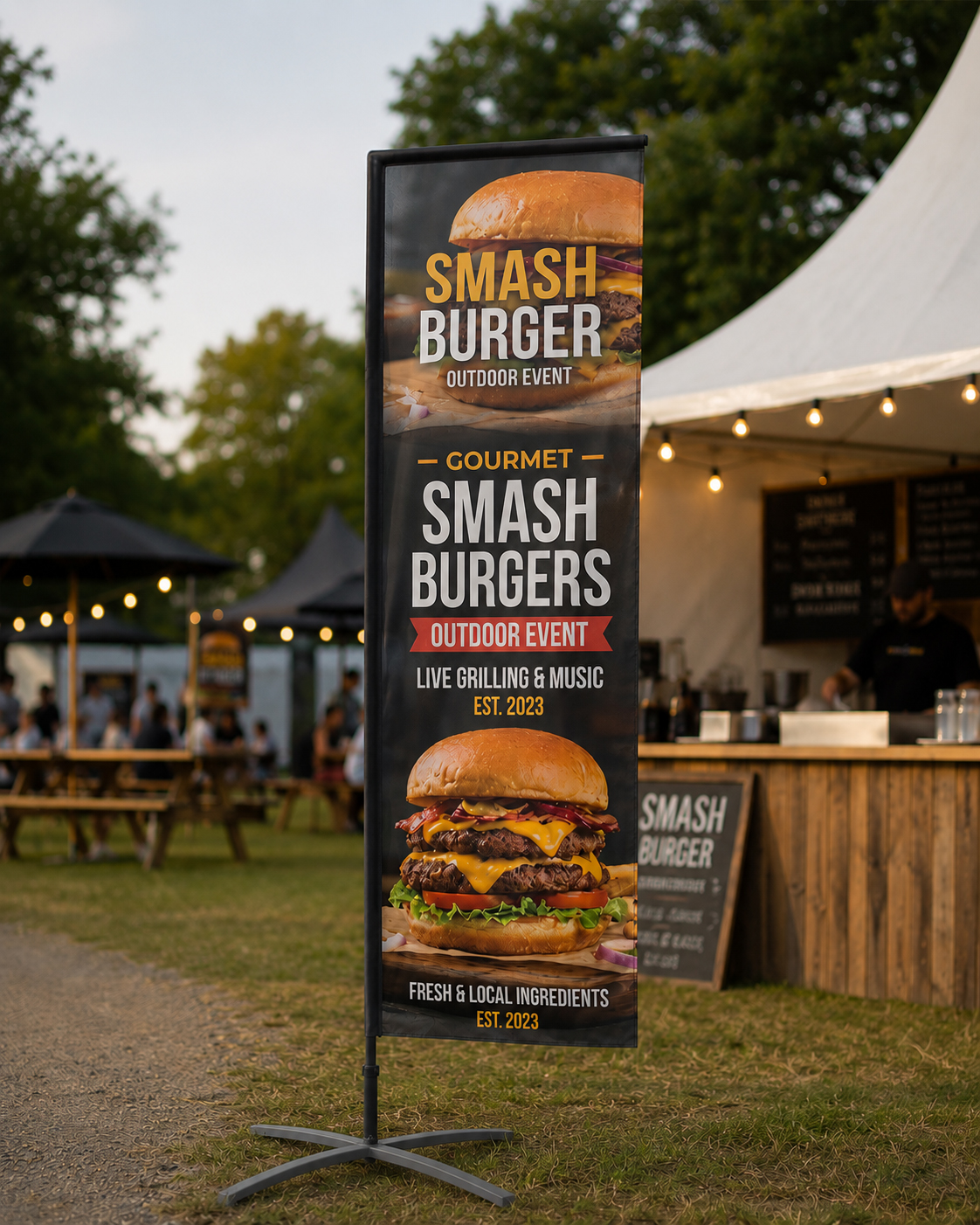
Rectangular format for signage, promotions and messages that need a more regular graphic surface.
View productTeardrop flying banner or teardrop flag
The teardrop flag is one of the most popular formats. Its shape resembles an inverted drop or teardrop, with a curved upper section and a narrower lower area. This silhouette helps keep the fabric quite taut, resulting in a clean and clear image.
This type of flying banner is ideal for short messages, large logos and eye-catching designs. It works very well at sporting events, beaches, shops, trade fairs, outdoor promotions and brand activations.
- Ideal use: shops, sporting events, outdoor fairs and high-impact exterior promotions.
- Key advantage: the fabric stays taut and clearly visible, keeping the design legible from a distance.
Spoon Pro
Professional teardrop option for outdoor campaigns, events and points of sale.
View product
Spoon Basic
Economic teardrop alternative for temporary promotions and basic visual communication.
View productSail type flying banner
The sail type flying banner has a more elongated and elegant shape. Its design resembles a nautical sail, with a strong vertical line and a curved drop. It is a format widely used by brands seeking a more stylish and professional image.
This model works well at trade fairs, conferences, corporate events, company entrances, hotels, dealerships, sports centres and outdoor promotions. Its height provides visibility, while its shape gives a polished look.
- Ideal use: corporate events, hotels, dealerships and settings where brand image requires elegance.
- Key advantage: its stylish silhouette conveys professionalism and distinction compared with more conventional displays.
Knife Pro
Sail type flag for brands looking for an elegant and professional vertical presence.
View product
Knife Basic
Economic sail-shaped format for promotions, trade fairs and temporary campaigns.
View productRectangular flag banner
The rectangular flag banner is closer to the traditional shape of a flag. Its main advantage is that it offers a more regular surface, which makes it easier to place text, images or slightly more complete compositions.
This format can be useful when you need to communicate more information: a percentage discount, a product category, an address or a more developed call to action. However, it should not be overloaded: a flying banner must be read quickly.
- Ideal use: indoor signage, information points, exhibitions and situations where a larger regular graphic surface is required.
- Key advantage: a regular surface that makes more complete compositions easier and makes better use of the design space.
Square Pro
Professional rectangular flag for clear messages, signage and visible promotions.
View product
Square Basic
Economic rectangular version for temporary campaigns and information points.
View productWhich flying banner should you choose according to your needs?
Teardrop type
Ideal for: outdoor promotions, sporting events, beaches, shops and eye-catching campaigns.
Its curved shape keeps the fabric more taut and helps the design look clean with short messages.
Sail type
Ideal for: trade fairs, hotels, dealerships, corporate events and company entrances.
Its elongated silhouette conveys a more stylish and professional image, especially in large spaces.
Rectangular
Ideal for: signage, information points, promotions and messages with more content.
Its regular surface makes it easier to organise the composition and make better use of the print area.
| Flag type | Recommended use | Strong point | When to choose it |
|---|---|---|---|
| Teardrop type | Sporting events, beaches, outdoor promotions and shops. | Dynamic design and fairly taut fabric. | When you want visual impact with a short and striking message. |
| Sail type | Trade fairs, hotels, dealerships, companies and corporate events. | Stylish silhouette and professional appearance. | When you want an elegant flag that is visible from a distance. |
| Rectangular | Signage, information points, exhibitions and promotions. | Larger regular surface for organising content. | When you need to include a little more information without losing clarity. |
How to choose the right flying banner
Format, size and base
The location defines the advertising flag you need
Choosing a flying banner is not just about selecting the most attractive model. To get it right, you need to consider several factors: where it will be placed, what its objective is, what size you need, which base is suitable and what the design will look like.
An indoor flag does not need the same base as an outdoor flag. Likewise, a shop promotion does not require the same size as signage that needs to be visible from a car park or sports area.
Define the objective of the flying banner
Before buying a custom flying banner, it is worth defining its main purpose. It can be used to attract customers, announce a promotion, reinforce brand image, signpost an area or highlight a product.
If the aim is to attract people to a store, the message should be direct: "Sale", "Offer", "New", "Promotion" or "Come in and discover". If the aim is signage, clarity is the most important factor. Once the objective is clear, it becomes much easier to choose the format, size and design.
Choose the size according to the reading distance
The size of the flying banner should match the place where it will be installed. Indoors, in small stands or in areas where the public passes close by, a compact or medium format may be enough. In large outdoor areas, car parks, sporting events or dealerships, larger sizes may be a better option.
The key is to think about where the public will see the advertising flag from. If it will be viewed from a few metres away, a medium size may work well. If it needs to be seen from a distance, it is better to choose greater height and a very clear design.
Choose the right base for your advertising flag
The base is essential for keeping the flying banner stable and safe. There are different types of bases depending on the floor and environment:
- Cross base: for indoor spaces or trade fairs. Lightweight, easy to transport and practical for protected areas.
- Fillable base with water or sand: recommended for outdoor use on hard floors.
- Ground spike: ideal for grass, soil or sand at outdoor events.
- Wheel base: widely used in dealerships and automotive events.
Technical recommendation
Stability is just as important as the graphic. If the flying banner will be placed outdoors, choose a base compatible with the ground surface and remove the flag in strong wind or adverse weather conditions.
Designing a custom flying banner
Design is one of the factors that most influences the final result. A custom flying banner must be visible, legible and consistent with the brand. It is not about filling the entire surface with information, but about communicating a clear message in just a few seconds.
In outdoor advertising and point-of-sale communication, simplicity usually works better than complexity. People do not stop for long to read a flag. They see it while walking, driving or passing through a transit area. That is why the design must be understood at a glance.
Use a short and direct message
The main message of a flying banner should be short. A word or a brief phrase is usually enough: "Sale", "Special offer", "New opening", "Menu of the day", "Outlet" or "Last days".
A good advertising flag design answers a simple question: what should someone understand in three seconds? If the answer is not clear, it is better to simplify.
Respect brand colours and identity
The custom flying banner should be aligned with the company’s visual identity. Corporate colours, logo and typography help make the brand recognisable. However, legibility must also be considered: if the brand colours do not contrast well, they may need to be adapted.
A design with good contrast, clean spaces and well-organised elements will communicate a more professional image. In contrast, an overloaded or unclear composition may have the opposite effect.
Prepare the print file correctly
To achieve a good result, the flying banner file must be prepared with sufficient quality. Ideally, work with the template of the chosen model, respect the safety areas and avoid placing important text too close to the edges.
The logo should be high quality, preferably in vector format. Images should have a suitable resolution for printing. In formats such as the teardrop flag, it is especially important to adapt the composition to the curved shape.
Most frequent uses of a flying banner
The flying banner is used in many sectors because it adapts to different needs. It can be used to sell, inform, guide, decorate or reinforce a brand. Its versatility makes it a very useful display for both small businesses and large companies.
Shops and retailers
It helps highlight the entrance and announce sales, promotions, new products, clearance campaigns, seasonal campaigns or openings.
Trade fairs and events
It helps people locate a brand in spaces with many stands, exhibitors and visual stimuli.
Hospitality
It can be used to advertise menus, terraces, breakfasts, promotions or specialities in bars, restaurants and cafés.
Flying banner for shops and retailers
In shops and retail spaces, the flying banner helps highlight the entrance and attract customers. It can announce sales, promotions, new products, clearance campaigns, seasonal campaigns or openings. Placed next to the door, it acts as a visual hook that invites people to look at the window display or enter the store.
Flying banner for trade fairs and events
At trade fairs, conferences and events, the flying banner helps make a brand easier to find. In a space full of stands, displays and visual stimuli, a vertical flag can make a difference. It can be placed in a corner of the stand, next to a counter or in an access area.
Flying banner for hospitality and restaurants
Bars, restaurants, cafés, ice cream shops, food trucks and takeaway businesses can make excellent use of a flying banner. It can be used to announce menus, terraces, breakfasts, promotions or house specialities.
Flying banner for real estate agencies
Real estate agencies and property developers can also benefit from a custom flying banner. It is very useful for signposting sales offices, new-build developments, open house events or show homes. Messages such as "New development", "For sale", "To rent" or "Last units" work very well.
Flying banner for automotive businesses
In dealerships, used car sales, workshops and automotive events, the flying banner is a very common display. These spaces are often large and visibility from a distance is essential. It can be used to highlight used vehicles, finance offers, workshop services or special campaigns.
Flying banner for sporting events
Sporting events are one of the settings where the teardrop flag and other flying banner models work best. Popular races, tournaments, camps, gyms, clubs and competitions use these displays to signpost, sponsor and decorate.
Flying banner for indoor and outdoor use
One of the great advantages of the flying banner is that it can be used both indoors and outdoors. However, each environment requires some specific considerations.
Indoors, the display is mainly used to reinforce the brand, decorate spaces, signpost areas or highlight promotions. As there is no wind, lighter bases can be used and designs can include slightly more detail. It works very well at trade fairs, shops, shopping centres, reception areas, gyms and showrooms.
Outdoors, the flying banner has to compete with more visual stimuli and withstand reasonable environmental conditions. That is why it is important to choose a stable base, an appropriate size and a very legible design. The base should be chosen especially carefully, and the flag should be removed in strong wind, heavy rain or adverse weather conditions.
Tips for assembling and caring for your flying banner
Assembling a flying banner is usually simple. In most cases, you only need to connect the pole sections, insert the pole into the fabric, secure the lower part if applicable and place the whole set onto the base. Although the process is easy, it is worth doing carefully to avoid damage.
To assemble a flying banner correctly, first lay out all the parts and check that everything is complete. Then assemble the pole following the indicated order. Next, insert the rod into the fabric sleeve until it takes the correct shape. Before finishing, check that the whole display is stable, straight and facing the area of greatest visibility.
For maintenance, it is advisable to store the flag clean and dry. The fabric should be cleaned gently, avoiding harsh products that could damage the print. The structure should also be checked periodically to make sure the parts fit properly. A well-maintained custom flying banner can be reused for a long time.
Common mistakes when buying a flying banner
Although the flying banner is a simple product, some mistakes can reduce its effectiveness:
- Choosing the wrong size: a flag that is too small may go unnoticed; one that is too large may be uncomfortable in smaller spaces.
- Not paying attention to the base: stability is essential, especially outdoors. The wrong base can cause falls or a poor user experience.
- Overloading the design: the flying banner must communicate quickly. If too many texts, images or elements are included, the message becomes confusing.
- Not adapting the design to the format: each format has its own shape and proportion. A design created for a rectangular poster does not always work on a teardrop flag.
- Using text that is too small: the public will see the advertising flag from a distance and often while it is moving. It is better to use few words, large letters and high contrast.
- Choosing the base only by price: the cheapest base is not always the most suitable. If the flying banner will be used outdoors or on a specific surface, choose a base compatible with that use.
The flying banner, a visible, practical and profitable solution
The flying banner is much more than a simple decorative flag. It is an effective, versatile and easy-to-use advertising display, capable of improving the visibility of any business, event or promotional campaign.
As an advertising flag, it can highlight an entrance, guide the public, announce an offer or reinforce brand image. The key to getting it right is choosing the right format, size, base and design. A teardrop flag can be perfect for dynamic impact; a sail-shaped model can provide a more elegant image; and a rectangular format can be very practical when a more regular surface is needed.
At Cashdisplay you will find a wide selection of advertising flag banners to create the visual display your business needs. Choose your flying banner, customise it with your brand image and start standing out in stores, trade fairs, events and promotional campaigns.
Make your business visible at first glance
Find teardrop, sail and rectangular flag banners, plus accessories to create a practical, visible and reusable advertising flag.
Frequently asked questions about flying banners
We answer the most common questions about formats, outdoor use, design and placement of an advertising flag so you can choose the most suitable option for your business or event.
What is a custom flying banner?
A custom flying banner is an advertising flag printed with the design of a company, brand, campaign or event. It can include a logo, corporate colours, promotional messages, images or signage.
Where can I place an advertising flag?
An advertising flag can be placed at shop entrances, trade fairs, events, terraces, dealerships, sports centres, sales offices, beaches, car parks or walkway areas. The location should be visible, safe and suitable for the type of base.
Which format is best: teardrop, sail or rectangular flag banner?
It depends on the objective. The teardrop flag is eye-catching and dynamic. The sail format is elegant and stylish. The rectangular flag banner makes better use of a regular surface for slightly more complete messages.
Can a fly banner be used outdoors?
Yes, a fly banner can be used outdoors if you choose a suitable base and take weather conditions into account. In strong wind or bad weather, it is advisable to remove it.
What should a flying banner design include?
A flying banner design should include a clear message, the logo or brand element and colours with good contrast. Ideally, avoid long texts and focus on one main idea.


