

Taking part in a trade fair or commercial exhibition can be one of the most effective strategies for increasing your brand visibility, generating leads and closing sales. But for the experience to be successful, it is essential to know how to set up a stand at a trade fair with efficiency, creativity and strategy.
In this complete guide, we will show you all the essential steps, as well as expert tricks so that you learn how to set up a stand, with practical advice that will help you stand out at any event. Throughout the text, we will focus on how to achieve a stand that is attractive, functional and aligned with your marketing objectives.
Table of contents
- Step 1: Define your objectives and the type of trade fair
- Step 2: Choose the stand location
- Step 3: Design your stand with visual impact
- Step 4: Choose the essential elements
- Step 5: Prepare your promotional material
- Step 6: Logistics and assembly
- Step 7: Bring your stand to life during the fair
- Step 8: Closing, dismantling and follow-up
- Expert tricks to stand out
Step 1: Define your objectives and the type of trade fair
Before thinking about design or logistics, it is crucial to define what you want to achieve with your participation:
- Lead generation: collect details from interested visitors.
- Direct sales: close agreements during the event.
- Product launches: present innovations to the market.
- Brand reinforcement: increase recognition and prestige.
You must also be clear about the type of event: professional, B2B, B2C, themed, international, etc. This will influence the size of the space, the style of the stand and the message to communicate.
Also analyse your competitors and the expected audience. A local fair may require a different strategy from an international exhibition with major media coverage. Research previous fairs, consult the organisers and adapt your proposal.
Step 2: Choose the stand location
At trade fairs, location is everything. Whenever possible, select spaces in high-traffic areas: close to entrances, corners, mandatory passage areas or near anchor brands. Being at the nerve centre of the event can make the difference between being seen or going unnoticed.
Also consider the orientation of the stand, its proximity to services such as cafés or rest areas, and the layout of the pavilion. Do not hesitate to invest a little more if that ensures better exposure.
Step 3: Design your stand with visual impact
Good design is the key to attracting visitors. If you are wondering how to set up a beautiful stand, these are the essential aspects:
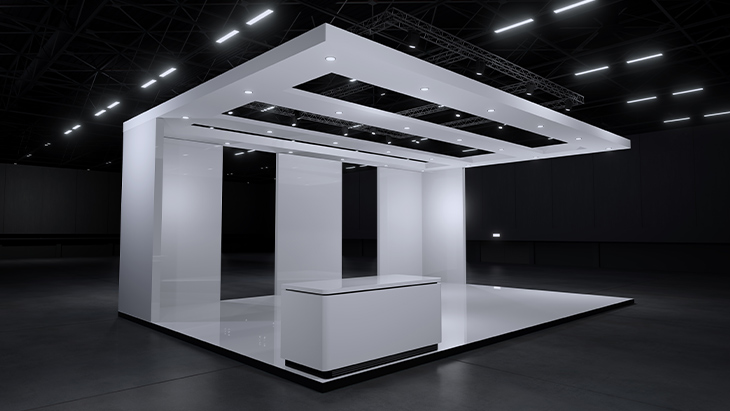
- Open design: avoid closed structures and encourage smooth access. Visitors should feel invited to enter.
- Brand colours: use your corporate palette to reinforce identity. Visual consistency builds recognition.
- Quality materials: they convey professionalism. Well-finished wood, metal, textiles or plastics make the difference.
- Attractive graphics: include screens, vinyls and high-impact signage. The information must be clear and visible from a distance.
- Effective lighting: highlight key areas and create a welcoming atmosphere. Play with cool and warm lights to create contrast.
Also think about the visitor experience. The design should make circulation easier, offer interaction areas and reflect the values of the brand.
Step 4: Choose the essential elements
Every functional stand should include:
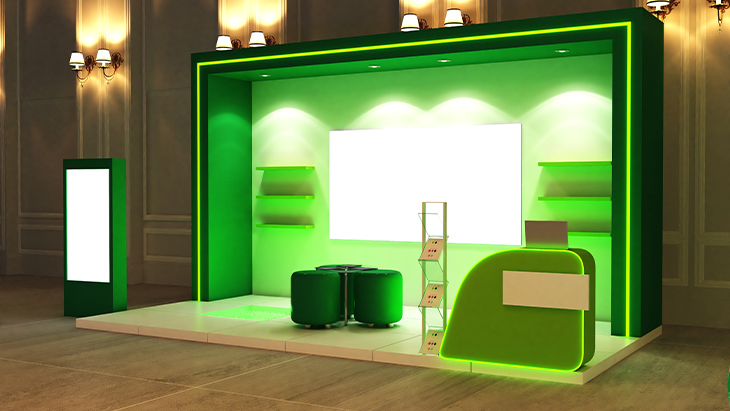
- Furniture (counters, tables, chairs): choose ergonomic and adaptable designs.
- Hidden storage (for catalogues, bags, products): keeping everything tidy conveys professionalism.
- Visual supports (roll ups, displays, pop-ups or brochure holders): they help communicate key information without saturating the space.
- Branding (visible logo, consistent colours): reinforces identity and makes your stand recognisable.
- Meeting or demonstration area if space allows: ideal for closing deals or presenting new products.
You can also incorporate resources such as illuminated display cases, rotating displays or modular shelving. The key is to combine aesthetics and functionality.
Step 5: Prepare your promotional material
It is not only about the physical space; you also need:
- Catalogues and brochures: well designed, up to date and aligned with your campaign.
- Business cards: essential for networking.
- Promotional gifts (merchandising): pens, bags, gadgets. Make sure they carry your brand.
- Audiovisual resources: product videos, testimonials, presentations.
- Lead capture forms: on paper or digital. Make data collection easy.
Also consider taking a QR code that leads to your website, online catalogue or contact form.
Step 6: Logistics and assembly
This step is key to answering the question of how to set up a trade fair stand successfully:
- Check the fair assembly schedule: respect the assigned times.
- Hire a specialised team or train your staff to install the stand.
- Bring basic tools and spare parts: tape, screwdrivers, bulbs, chargers.
- Carry out technical tests on lights, screens and connections before the start.
Do not underestimate unexpected issues. Having a plan B for electricity, internet or structural failures can save your participation.
Step 7: Bring your stand to life during the fair
A beautiful stand is useless without action. Here are some ideas:
- Prize draws and competitions: they generate traffic and collect data.
- Live demonstrations: ideal for technical or innovative products.
- Free samples: they allow visitors to try your product and start a conversation.
- Gamification actions: wheels, challenges, prize games.
- Well-trained and proactive staff: your team’s attitude defines the experience.
Also incorporate digital tools: tablets for surveys, digital displays or social media filters. Everything adds value.
Step 8: Closing, dismantling and follow-up
Once the fair is over:
- Collect all material in an organised way: inventory and pack everything correctly.
- Assess the condition of each component: decide what can be reused.
- Thank your team and the contacts generated: create lasting relationships.
- Prepare a report with the results obtained: visitors, contacts, sales, lessons learned.
- Follow up immediately with leads: personalise messages and offer continuity.
Success does not end with the fair. The real return is measured in the following months.
Expert tricks to stand out
- Design with Instagram in mind: create photogenic areas that invite sharing.
- Include a differentiating element: a sculpture, a curved screen, a characteristic scent.
- Always have staff available to explain, guide and smile: attitude is everything.
- Choose modular and reusable solutions for future fairs: economy and sustainability.
- Create memorable experiences: augmented reality, ambient music, tastings.
Knowing how to set up a stand at a trade fair is not only a technical matter; it is a complete branding, communication and sales strategy. With good planning, effective design and flawless execution, your participation can become one of the most profitable actions of the year.
The key lies in coherence, visual impact, attraction capacity and constant action. It is not only about being present, but about standing out and leaving a mark.
At Cashdisplay, we offer all the solutions you need for stands, fairs and exhibitions. Browse our catalogue and bring your next event to life.


