

In the world of marketing and visual communication, where every small detail counts, choosing the right paper is not just a technical task; it is a strategic decision that can make the difference between going unnoticed and truly connecting with your audience.
Imagine a business card that, just by touch, already tells you that the person handing it to you cares about details. Or a leaflet that, thanks to its shine and vividness, makes you stop and look. The type of paper for printing that we choose is the first ambassador of our brand. It is not just about choosing between white or coloured paper, but about understanding the magic behind paper weight, thickness, whiteness, texture, opacity and how all of this works with inks and the different types of paper printing.
If you are a designer, entrepreneur or simply someone who wants their printed messages to leave a mark, this article is for you. We are going to break down the main types of paper for printing, looking at what each one is used for and what you need to take into account in your printing and binding projects.
Table of contents
- Why Does Paper Matter So Much? The First Impression Counts
- Let’s Talk About Paper Weight, Thickness and Whiteness: The Basics of Paper
- Types of Printing: Each Paper with its Technique
- Types of Paper for Printing: Surfaces that Tell a Story
- Printing and Binding: An Indivisible Team
- Choosing the Perfect Paper: Tips to Keep in Mind
- Your Choice of Paper, the Soul of Your Message
Why Does Paper Matter So Much? The First Impression Counts
Choosing the right paper is key because it directly affects how your message is perceived. Good paper enhances colours and text clarity, influencing whiteness, ensures that your material withstands use and external conditions, thanks to paper weight and thickness, and communicates the essence of your brand, whether luxury through texture or dynamism through a glossy finish. In addition, understanding the options helps you optimise your budget and ensure that the paper is compatible with the printing technique, avoiding problems and waste. In short, paper is an investment in the quality and effectiveness of your communication.

Let’s Talk About Paper Weight, Thickness and Whiteness: The Basics of Paper
Before diving into the different types of paper for printing, it is important to become familiar with three basic concepts that will help us understand everything better: paper weight, thickness and whiteness.
Paper Weight: How Much Does Your Message Weigh?
Paper weight is simply the weight of the paper per square metre, and it is measured in grams per square metre (g/m²). Think of it as an indicator of the consistency of the paper. Although a higher paper weight usually means thicker and stiffer paper, they are not the same thing.
Quick Guide to Paper Weights and Their Uses:
Lightweight (up to 90 g/m²):
- 50-70 g/m²: Typical newspaper paper or the most basic photocopy paper. Very light and somewhat transparent.
- 70-90 g/m²: Everyday office paper, simple leaflets or the inner pages of budget magazines. It is your base for reading documents.
Medium (100-170 g/m²):
- 100-120 g/m²: Letterhead with more body, advertising leaflets that you want to feel better, or the pages of a good quality book or magazine. It provides a good balance between flexibility and opacity.
- 130-170 g/m²: Ideal for small posters, higher quality flyers, bi-folds or tri-folds. Here, a more robust feel is already noticeable.
Heavyweight (170 g/m² and above):
- 170-250 g/m²: This is where card stock territory begins. Perfect for greeting cards, magazine covers, calendars or medium-sized posters.
- 250-350 g/m²: The star paper weight for business cards, postcards or special invitations. It conveys quality and withstands frequent handling very well.
- More than 350 g/m²: Very thick card stock, almost cardboard. It is used for rigid packaging, luxury book covers or countertop displays that require maximum firmness.
A higher paper weight usually communicates greater quality and durability, but it also means a higher cost and weight, which is important if shipping is involved.
Thickness: The Feel in Your Hand
Paper thickness is measured in microns (µm) and is, literally, how thick the paper is. Although it goes hand in hand with paper weight, it is not identical. Two papers with the same paper weight can have different thicknesses if their density is different. A thicker paper usually gives a greater feeling of solidity and, again, more quality. Think about the difference between touching a thin business card and a thick one!
Whiteness: The Perfect Canvas for Your Colours
Paper whiteness is simply how "white" it looks, or how much light it reflects. It is measured using technical scales such as ISO or CIE. A whiter paper makes printed colours appear more vivid, with more contrast and brightness. However, whiter is not always better. For reading very long texts in a book, for example, a slightly cream or off-white tone, with less whiteness, can be much more comfortable for the eyes.
- High whiteness: If your design includes lots of photos, striking graphics or needs colours that "pop", this is your option.
- Medium/low whiteness: Ideal for long texts, recycled papers or if you are looking for a more natural and soft finish.
Types of Printing: Each Paper with its Technique
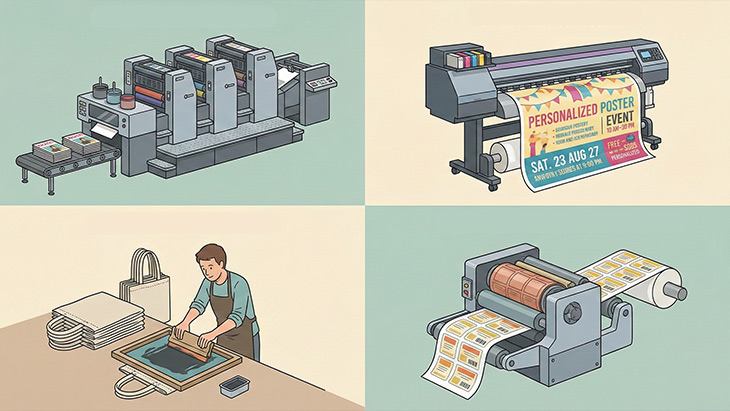
The choice of paper is closely linked to the printing method you are going to use. Each type of paper printing has its own particularities and reacts differently with each substrate. Knowing the main ones will help you avoid mistakes and achieve the best result.
Offset Printing: Power for Large Volumes
How does it work? It uses metal plates that transfer the image to a rubber cylinder and from there to the paper. It is an indirect process.
Ideal for: When you need to print thousands or millions of units: leaflets, magazines, books, posters. It is the queen of large print runs.
Paper compatibility: A marvel of versatility. It works well with almost all types of paper for printing, from uncoated offset paper to coated paper for printing in all its variants.
Pros: Impeccable image quality, very accurate colours, including Pantone, and the lowest unit cost for large productions.
Cons: It requires a significant initial investment in plates and preparation, so it is not profitable for small print runs.
Digital Printing: Flexibility and Instant Personalisation
How does it work? It prints directly from the digital file onto the paper, using toner, like a large photocopier, or inkjet, without the need for plates.
Ideal for: Small or medium print runs, from a single copy to a few thousand, projects with variable data, where each copy is different, prototypes or print tests.
Paper compatibility: Very good with most types of paper for printing, including coated paper for printing and offset paper. For very textured or special papers, it is better to do a test.
Pros: Fast production, you can print from just one unit, it allows each copy to be personalised, and initial costs are minimal.
Cons: The unit cost is usually higher than offset for large print runs. There are some limitations with special inks, such as metallic or fluorescent inks.
Screen Printing: The Art of Textures and Special Effects
How does it work? Ink is pushed through a mesh screen onto the areas that are not blocked by a stencil.
Ideal for: Printing on almost any surface, not just paper: textiles, plastics, ceramics. Also for creating very special effects on paper: thick ink layers, metallic colours, fluorescent colours or a UV varnish that adds relief and shine.
Paper compatibility: Very adaptable. You can print on Kraft paper, thick papers, cardboard and papers with marked textures.
Pros: Super vivid and opaque colours, great durability and the possibility of creating unique tactile textures.
Cons: Slower than other techniques for large volumes. It is not the best option for very fine details or photographs with many gradients.
Flexography: The Robust Solution for Packaging and Labels
How does it work? It uses flexible relief plates and fast-drying liquid inks that are transferred directly to the substrate.
Ideal for: Flexible packaging, such as bags and films, self-adhesive labels, newspapers and packaging.
Paper compatibility: Excellent for printing papers such as Kraft and cardboard, as well as plastic materials.
Pros: Very high printing speed, ideal for large volumes and works well on irregular surfaces.
Cons: Lower detail quality compared with offset.
Types of Paper for Printing: Surfaces that Tell a Story
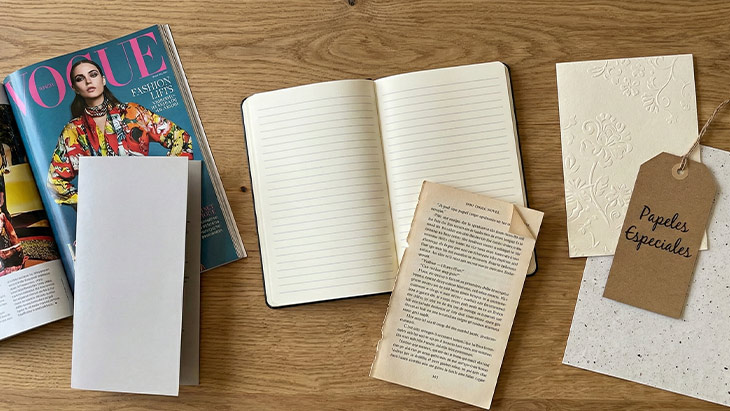
Beyond paper weight and printing method, the surface finish of the paper is what gives it personality. It is what makes paper feel smooth, glossy, rustic or elegant.
Coated Paper (Couché): The Bright Side of Printing
If you want your photos and colours to look vibrant and true to life, coated paper for printing is your best ally. Its surface is coated with a layer of minerals that makes it very smooth and uniform. This "coating" prevents the ink from being absorbed excessively, allowing colours to remain pure and images to look sharp and detailed.
Coated paper for printing is perfect for:
- Fashion magazines and high paper weight publications.
- Catalogues and leaflets for high-end products.
- Business cards that want to stand out with photographs.
- Posters with quality images and art books.
Within coated printing papers, you have three main options:
- Gloss Coated Paper: Its smooth and very glossy surface makes colours and photos look super vivid, with high contrast and a touch of modern luxury. Bear in mind that it can create reflections and show fingerprints more easily, and it is not ideal for large amounts of text due to visual fatigue.
- Matt Coated Paper: With a smooth but non-gloss finish, it offers a more sober and elegant look. It is perfect for long texts, as it does not reflect light, and images appear softer and deeper. Colours may be slightly less intense than on gloss paper, but it gains in readability and pleasant touch.
- Silk/Semi-Gloss Coated Paper: It is the perfect balance. It has a subtle silky shine that combines the colour vividness of gloss paper with the reading comfort and fewer reflections of matt paper. It is an incredibly versatile all-round option for almost any project.
Offset Paper (Uncoated): The Basis of Your Everyday Use
Offset paper is the one you use to print your office documents, or the paper in a book you read. Its surface does not have the coating of couché paper, so it is more porous and natural. The ink is absorbed a little more, which can make colours look less "pop" than on coated paper, but it gives it a warmer and more organic feel.
Offset paper is the fundamental support for:
- Office documents, letters, notepads, forms.
- Books with lots of text, such as novels and manuals, where reading comfort is key.
- Newspapers, budget magazines and informative leaflets.
- Any material you will need to write on by hand after printing.
Common Variants of Offset Paper:
- Bond paper: The most basic and widespread paper, for almost all everyday printing.
- Laid paper: It has fine visible lines in its texture, giving it a classic and elegant touch. It is used in prestigious corporate stationery.
- Cream or off-white paper: With a slightly yellowish tone, very popular for books because its lower whiteness reduces eye strain.
Special Papers: When You Want to Make a Difference
In addition to the "classics", there is a collection of printing papers with unique properties that can give your projects a very personal touch. They are perfect if you want to move away from the ordinary.
Recycled Paper: Your Commitment to the Planet
Characteristics: Made with recovered fibres. Nowadays, there are recycled papers with excellent whiteness and softness, far from the "greyish" look of the past.
Advantages: It is the most eco-friendly option! You communicate a clear commitment to environmental responsibility.
Applications: Corporate reports, leaflets for environmentally conscious companies, stationery for "green" brands.
Kraft Paper: Rustic Charm and Resistance
Characteristics: The typical brown paper, robust and with a natural texture, often with visible fibres. It usually has a high paper weight so it holds up well.
Advantages: It conveys a handcrafted, organic and authentic image. It is very resistant and works brilliantly with minimalist designs.
Applications: Packaging, labels, business cards with a vintage or natural touch, rustic invitations.
Printing on Kraft paper: It is crucial to remember that the brown base colour affects inks. Light colours may not show as much, while dark colours and white, printed with opaque ink or screen printing, can stand out.
Textured Papers: A Caress for the Senses
Characteristics: They have embossed patterns on their surface, such as linen effect, embossing, hammered texture and others. They usually have higher thickness and paper weight so the texture is noticeable.
Advantages: They add a tactile dimension that elevates the perception of quality and luxury, creating a multisensory experience.
Applications: Exclusive business cards, wedding invitations, very special book covers, premium packaging.
Synthetic Papers: Extreme Durability
Characteristics: Made with plastics, such as polypropylene or polyester. They are waterproof, tear-resistant and resistant to sun, humidity and chemicals.
Advantages: They withstand almost anything. Perfect for very harsh conditions.
Applications: Maps, restaurant menus, which are cleaned and handled a lot, outdoor product labels, long-lasting signage, event badges.
Photographic Paper: The Glory of the Image
Characteristics: A very high paper weight coated paper for printing with special coatings designed so photos appear at maximum quality.
Advantages: Incredibly vibrant colours, high level of detail and a superior tonal range. Your photos will look like works of art!
Applications: High-resolution photographs, albums, professional photographic exhibitions.
Printing and Binding: An Indivisible Team
For projects such as books or magazines, the choice of paper is essential because it directly influences how it is bound and the durability of the final result.
When binding, it is key to consider:
- Paper Weight and Thickness: Thicker and heavier papers for covers, and a medium paper weight (90-130 g/m²) for inner pages, making page turning easier.
- Grain Direction: It is important that the paper fibres follow the direction of the spine to prevent pages from deforming or tearing.
- Finish: Covers usually use coated paper for laminated printing; textbook interiors prefer offset or cream paper with lower whiteness for greater reading comfort.
- Resistance: The paper must be strong enough to withstand staples, stitching or rings without tearing.
Depending on the type of binding, the paper varies:
- Paperback: Inner pages in offset or cream paper of medium weight; cover in high paper weight coated paper for printing (250-350 g/m²) with lamination.
- Hardcover: Inner pages in offset or coated paper; rigid cardboard cover lined with printed paper (laminated coated paper) or special materials.
- Spiral (wire-o): Versatile for different paper weights and finishes, ideal for 360-degree opening.
- Saddle stitching: Best for few pages and low to medium paper weights.
Choosing the Perfect Paper: Tips to Keep in Mind
With so many types of paper for printing, the choice can seem overwhelming. Here are some practical tips to make it easier:
- Define the Objective of Your Print: What do you want to achieve? A leaflet to inform, a card to impress, a poster to withstand rain? The purpose is your compass.
- Think About Your Audience: Who is it aimed at? If it is for children, choose a more resistant paper; if it is for a luxury client, a textured paper or a high paper weight coated paper for printing will speak for itself.
- Look at Your Design: Does it have lots of photos or is it all text? For vibrant photos, glossy coated paper. For lots of reading, matt coated or offset paper.
- How Long Does it Need to Last? This will tell you whether you need paper with a high paper weight, considerable thickness, or even synthetic paper or lamination.
- Adjust Your Budget: Some papers are more expensive. Define how much you can spend and look for the best quality within that range.
- Ask for Samples!: This is crucial. Touching and seeing printing papers in person will give you a much clearer idea of their texture, whiteness and how they react to light.
- Consult the Experts: If you have doubts, the professionals at Cashdisplay.com or your trusted printer can give you golden advice.
- Take Printing into Account: Make sure the paper you choose is compatible with the technique you are going to use. If you are going to print on Kraft paper, for example, ask how the background colour will be handled.
- Think Green: If sustainability is important for your brand, look for recycled paper options or papers with ecological certifications.
Your Choice of Paper, the Soul of Your Message
Choosing the type of paper for printing is not just another task on your list; it is an opportunity for your brand to express itself with all its strength. Every paper weight, every thickness, every level of whiteness, every texture and every printing and binding method contributes to the story you want to tell. From the professionalism of offset paper to the glamour of coated paper for printing, the authenticity of printing on Kraft paper or the unbreakable resistance of synthetic papers, every choice is a nuance that enriches your communication.
At www.cashdisplay.com, we understand that your visual communication must be impactful and exciting. That is why we not only offer you the knowledge to choose the perfect paper and printing techniques, but also a wide variety of high-quality display solutions and advertising displays. We want your prints not only to be seen, but to dazzle in any shop window, trade fair or event. We invite you to explore our catalogue and discover how we can help your designs truly connect, feel unique and leave a lasting impression. Take your visual communication to the next level with Cashdisplay!


