

In a market saturated with visual stimuli, where consumer attention is a scarce resource, window dressing emerges as a fundamental discipline within visual marketing. Far from being a mere decoration of display cases, it is a complex and carefully planned strategy that directly influences brand perception, customer experience and, ultimately, sales.
This guide is aimed at retail professionals, event organisers, marketing managers and visual designers who want to understand in depth what window dressing is, how it relates to visual merchandising and how to make the most of its full potential in competitive commercial environments.
Table of contents
- What is window dressing?
- Window dressing and visual merchandising: a powerful alliance
- Benefits of commercial window dressing
- Keys to successful window dressing
- Types of window dressing
- Current trends in visual merchandising and window dressing
- Conclusion: the shop window as the first silent salesperson

What is window dressing?
Window dressing is the art and technique of planning, designing and executing the visual presentation of shop windows in commercial establishments. Its aim is to capture the attention of passers-by, communicate the essence of the brand and encourage entry into the point of sale.
It is not simply about displaying products. Modern window dressing is based on telling visual stories, generating emotions and establishing an instant connection with the viewer. It relies on elements such as composition, lighting, colour, materials, typography and product merchandising to build a memorable experience.
Window dressing and visual merchandising: a powerful alliance
Although they are often used as synonyms, window dressing and visual merchandising are complementary concepts. While the former focuses on the shop window as an external impact point, the latter covers the design and arrangement of products throughout the interior commercial space. Together, they form an integrated visual communication strategy.
An attractive shop window can draw the customer in, but it is visual merchandising that turns that attraction into a coherent in-store experience, guiding the route, highlighting key products and facilitating the purchase decision.
Benefits of commercial window dressing
1. It increases foot traffic
An eye-catching shop window acts as a visual invitation. Its attractive design can transform simple passers-by into potential customers, generating quality traffic without the need for additional advertising investment.
2. It strengthens brand identity
Every element of the shop window communicates something. From colours to materials and the chosen theme, everything helps to build a coherent and recognisable brand image. A brand with a defined aesthetic is more memorable and trustworthy.
3. It makes product promotion easier
The shop window is the perfect stage to highlight new products, seasonal promotions or special campaigns. It allows you to create visual micro-campaigns aligned with global marketing objectives.
4. It creates an emotional experience
Effective window dressing does not only display, it moves people emotionally. It uses visual storytelling to connect with the viewer on an emotional level, increasing affinity and purchase intention.
Keys to successful window dressing
1. Design with a narrative
Every shop window should tell a story. This visual narrative can be inspired by brand values, seasons, cultural events or social themes. The important thing is that there is coherence between all the elements and that the message can be understood at a glance.
2. Lighting as a focusing tool
Good lighting does not only beautify; it also directs the eye. It is advisable to use directional spotlights to highlight star products, backlighting to create depth and lighting effects to generate specific atmospheres.
3. The right choice of materials and supports
The use of displays, modular structures, vinyls, textiles and POP material helps to integrate the shop window with its surroundings in a coherent way. These elements should be chosen according to the message, the budget and the desired durability.
4. Dynamism and frequent renewal
Constant updates maintain freshness and interest. A static shop window loses effectiveness over time. Renewing it every 3 to 6 weeks makes it possible to follow the commercial calendar and surprise regular visitors.
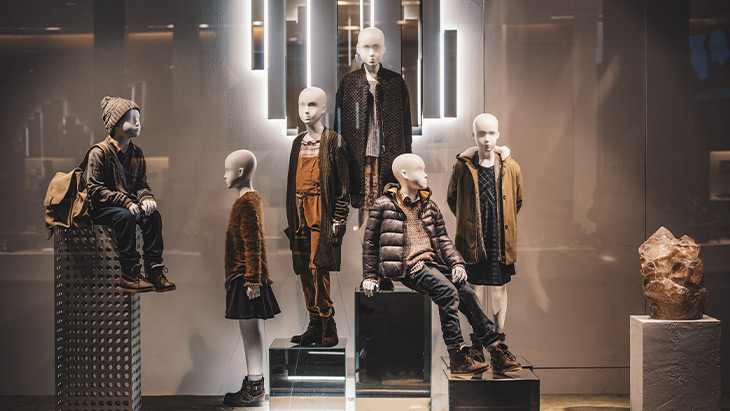
Types of window dressing
Seasonal window dressing
It adapts to festivities, seasons of the year or key dates (Christmas, sales, back to school). It is ideal for connecting with the consumer’s mood and generating purchase urgency.
Thematic window dressing
It develops a creative concept that may not be linked to a specific product, but rather to an idea or feeling. It requires careful execution so that the message does not become diluted.
Minimalist window dressing
It focuses on the idea of less is more. Few products, great attention to detail. Ideal for luxury brands or spaces that want to stand out for the purity of their design.
Interactive window dressing
It integrates technology (screens, sensors, augmented reality) to generate interaction with the public. It is especially effective in markets with young or tech-savvy audiences.
Current trends in visual merchandising and window dressing
- Sustainable materials: Ecological awareness encourages the use of recyclable or reusable elements.
- Immersive experiences: Creating environments that involve the senses (sight, smell, sound) for a 360º experience.
- Digitalisation: Shop windows that integrate screens, QR codes or display cases connected to e-commerce.
- Artistic collaborations: Work with artists or designers to turn shop windows into temporary galleries.
Conclusion: the shop window as the first silent salesperson
Ultimately, commercial window dressing is much more than a decorative trend: it is an essential communication and sales tool. When applied correctly, it directly influences the success of any commercial space, regardless of its size or sector.
Investing in window dressing means committing to a constant attraction strategy, visual differentiation and brand experience. In a world where everything enters through the eyes, the shop window becomes the first "silent salesperson" working 24 hours a day.
At Cashdisplay, we offer complete solutions for shop windows and visual merchandising that enhance your commercial strategy. Discover our catalogue and transform your space into an effective sales tool.


